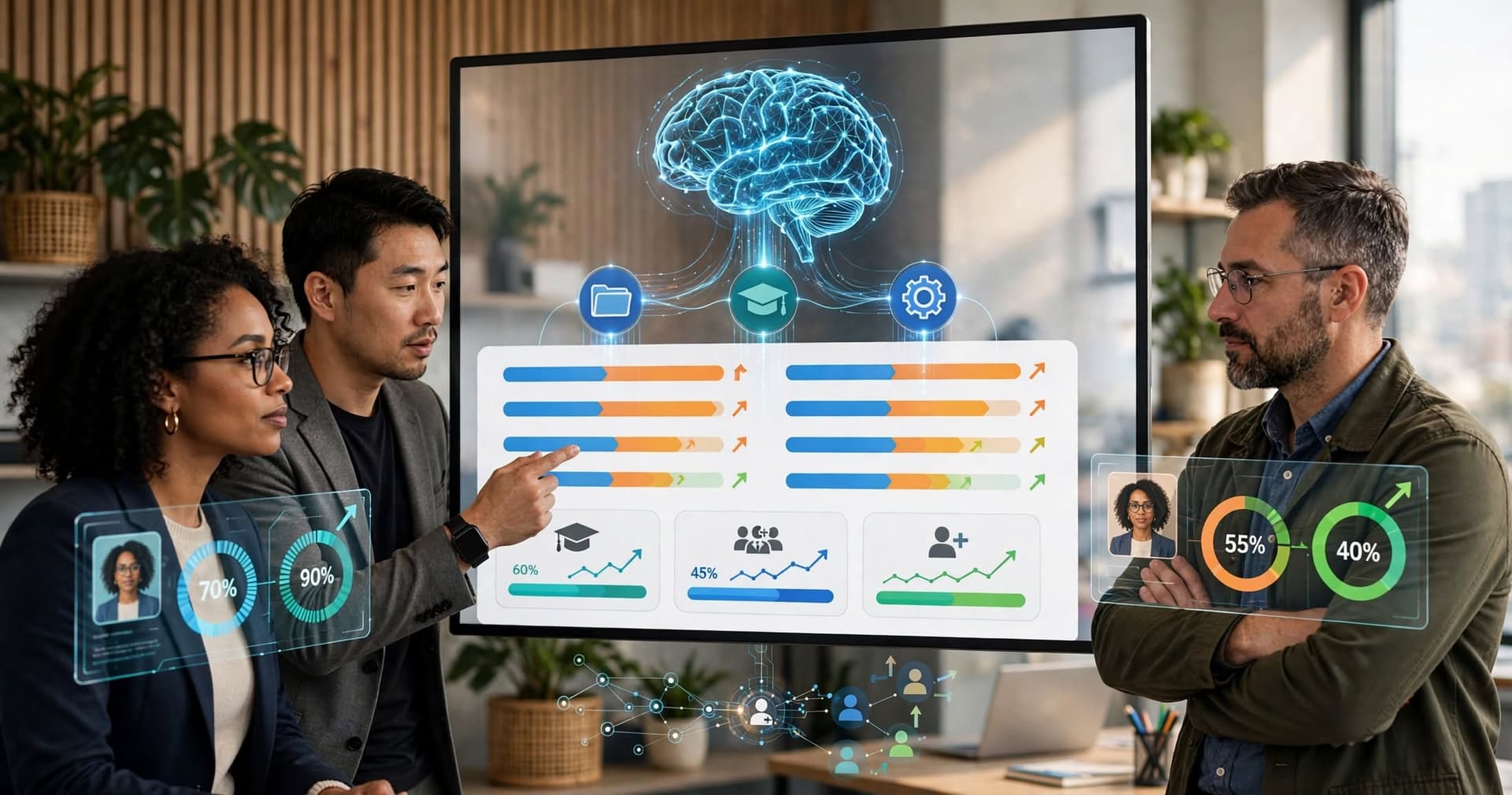
AI-driven employee skill gap analysis helps SMBs identify the capabilities they have, the capabilities they need, and the fastest ways to close the difference with targeted training, coaching, hiring, or automation. Done well, it turns workforce development from a generic HR exercise into a business planning tool tied to delivery capacity, technology adoption, cybersecurity readiness, and operational efficiency.
Key takeaways
- AI-driven skill gap analysis helps SMBs compare current employee capabilities against role requirements and business goals using real operational data, not guesswork.
- The best workforce development programs connect training priorities to specific workflows, systems, and roles instead of offering generic learning catalogs.
- For most small and mid-sized businesses, a useful first implementation starts with one department, one skills taxonomy, and a limited set of validated data sources.
- Human review is essential because AI can detect patterns and recommend likely gaps, but managers must verify context, performance expectations, and career paths.
- A practical SMB rollout typically takes weeks, not days, and costs vary based on data quality, integration complexity, and whether the company uses existing HR and LMS tools.
Why AI-based skill gap analysis matters more for SMBs
Small and mid-sized businesses usually do not have the luxury of carrying excess headcount, duplicating specialist roles, or waiting six months to discover that a new system rollout failed because the team lacked the right skills. When an operations lead, IT manager, or owner evaluates workforce development, the real question is not simply, “Who needs training?” It is, “What capabilities are required to support the business we are trying to run next quarter and next year?” AI-driven analysis is useful because it can connect scattered signals across HR systems, project tools, help desk tickets, code repositories, CRM workflows, and learning platforms to surface patterns a manual spreadsheet review often misses.
For SMBs, the stakes are especially high in areas like cloud migration, cybersecurity hygiene, e-commerce operations, workflow automation, and customer support. A business may think it has a staffing problem when it actually has a capability allocation problem: the knowledge exists, but it is concentrated in one person, trapped in one department, or not aligned to the systems the company depends on. AI can highlight role-specific gaps such as weak API integration skills in a web team, poor identity and access management knowledge in IT support, or limited prompt engineering and model governance understanding among managers adopting generative AI tools.
This is also where a technology partner can add value beyond training procurement. In our experience at BCW Technology Solutions, the most successful workforce development programs start with operational reality: what platforms are in use, what workflows break down, where security risk accumulates, and which roles are becoming bottlenecks. AI is not there to replace management judgment; it is there to speed up pattern detection and improve prioritization.
What “AI-driven” actually means in a practical SMB setting
Many articles treat AI skill analysis as if it requires a massive enterprise talent platform and years of historical data. In practice, SMBs can get meaningful results with a narrower, more disciplined approach. “AI-driven” usually means using machine learning, natural language processing, and rules-based scoring to normalize skill data from different sources, map employees to capability frameworks, infer likely proficiency levels, and recommend actions. The system may analyze job descriptions, ticket notes, project artifacts, certifications, peer feedback, training completions, assessment results, and even communication patterns if governance allows it.
Common supporting technologies include NLP models for extracting skill terms from resumes and internal documentation, vector search or embeddings for matching similar skills across inconsistent naming conventions, and classification models for grouping competencies into domains like cloud operations, secure coding, project management, customer communication, or data analysis. Some SMBs implement this within existing platforms such as Microsoft 365, Power BI, Viva, Copilot Studio, ServiceNow, Workday, BambooHR, Cornerstone, or a lightweight learning management system. Others use custom integrations that pull selected data into a secure warehouse on Azure, AWS, or Google Cloud and score it there.
The important point is that AI should not be treated as a black box. Business leaders should be able to answer basic questions such as: Which data sources were used? How are skills defined? How is proficiency inferred? Who reviews recommendations? What personal data is excluded? If those answers are unclear, the analysis may create more noise than insight.
Typical data inputs for an SMB pilot
- HR data: role titles, tenure, team structure, certifications, performance review themes
- Operational systems: ticket queues, incident categories, project assignments, backlog data, QA defects
- Technical artifacts: Git activity, documentation quality, infrastructure-as-code repositories, CI/CD logs
- Learning data: course completions, assessment scores, manager coaching notes, internal knowledge base usage
- Business context: strategic initiatives, planned software rollouts, compliance requirements, customer support trends
Building a skills framework that reflects actual work
The quality of the analysis depends on the quality of the skills taxonomy behind it. One of the most common mistakes is importing a generic competency library and assuming it reflects the company’s operating model. For an SMB, a useful framework should describe the capabilities required to deliver real work in your environment. That means tying skills to platforms, workflows, and risk areas, not just abstract labels like “communication” or “technical proficiency.”
For example, a managed IT team may need a framework that distinguishes Microsoft 365 administration, endpoint management, IAM policy design, phishing response, backup validation, and scripting for workflow automation. A commerce company may need separate capabilities for product data governance, Shopify or WooCommerce administration, conversion analytics, payment gateway troubleshooting, and customer journey optimization. A software team may need skill definitions around React, .NET, Node.js, mobile CI/CD, API design, secure SDLC, test automation, and observability using tools such as Datadog, Grafana, or Azure Monitor.
The framework should also define what proficiency looks like at different levels. “Knows AWS” is not actionable. “Can deploy and monitor a containerized application using ECS or Kubernetes, manage IAM roles, and troubleshoot common networking issues” is far more useful. This makes AI recommendations more credible because the system is matching people to observable tasks and deliverables rather than vague keywords.
How to define skills without overengineering
- Start with 20-40 critical skills for one department or initiative rather than cataloging every possible competency.
- Group skills into domains such as cloud operations, cybersecurity, software delivery, business systems, and customer operations.
- Define proficiency by behavior using concrete tasks, not self-rated confidence alone.
- Map each skill to business outcomes like reduced incident backlog, faster release cycles, stronger compliance posture, or better order processing accuracy.
- Review quarterly because required skills shift as platforms, vendors, and priorities change.
A step-by-step decision framework for implementation
For most SMBs, the right approach is incremental. Trying to score every employee across the entire organization on day one usually creates poor data quality, stakeholder resistance, and unclear ROI. A phased model works better because it lets leaders validate assumptions before expanding the program.
Step 1: Pick a business problem, not a tool. Start with a high-value question such as: Why is cloud support escalating so often? Why are e-commerce updates delayed? Why is our automation initiative dependent on one analyst? The skill analysis should answer a business problem that leaders already care about.
Step 2: Select one pilot group. Choose a team with measurable work outputs and enough data to analyze, such as help desk, application support, software delivery, or operations. A 15- to 50-person pilot is often manageable for an SMB.
Step 3: Define the target skill model. Document the required competencies, the roles involved, the expected proficiency levels, and the systems where supporting evidence exists. Include adjacent skills like documentation, vendor coordination, or security awareness if they materially affect outcomes.
Step 4: Inventory and clean data. Expect inconsistency. Job titles may be outdated, course histories may be incomplete, and project documentation may use different terms for the same skill. This is where light NLP normalization and manager review are useful.
Step 5: Score cautiously. Use AI to suggest likely proficiency bands or gap areas, but require manager validation before labeling an employee as “under-skilled.” Confidence scoring matters; a recommendation based on two weak signals should be treated differently from one backed by several data sources.
Step 6: Match interventions to the gap. Not every gap needs formal training. The right response might be a short lab exercise, shadowing a senior teammate, updated runbooks, a certification path, better process documentation, or hiring for one key role while reskilling others.
Step 7: Reassess after a defined cycle. A typical first cycle may run 6 to 12 weeks for analysis and action, followed by another review 60 to 90 days later. Measure operational indicators relevant to the pilot, such as rework, incident resolution quality, deployment delays, or audit readiness rather than relying only on course completion.
Turning analysis into tailored workforce development programs
The real value comes after the gap is identified. Too many companies stop at dashboards. Tailored workforce development means building learning paths that reflect role requirements, business timing, and the way adults in SMB environments actually learn: in short, applied bursts tied to active work. An engineer supporting Azure should not receive the same plan as a team lead evaluating AI workflow automation tools, even if both are broadly labeled “technical staff.”
A strong program usually blends several intervention types. For foundational knowledge, self-paced courses or vendor learning paths can work well. For operational transfer, sandbox labs, paired work, simulations, and runbook-based exercises are often more effective. For leadership roles, scenario workshops around risk, budgeting, vendor management, and governance may matter more than platform-specific labs. AI can help assemble these paths by recommending the smallest set of learning actions likely to close the gap for a specific role cluster.
Consider a few realistic examples. An SMB modernizing its infrastructure might find that system administrators understand virtual machines but lack skills in infrastructure as code, policy enforcement, and cost monitoring. The response could combine Terraform basics, Azure Policy practice, and a short governance workshop for IT leads. A growing online retailer might discover that the operations team can manage product listings but struggles with feed validation, analytics interpretation, and exception handling across marketplaces. In that case, the development plan should include platform-specific process training, dashboard literacy, and automation design for repetitive catalog updates.
Interventions that often work better than generic training catalogs
- Role-based learning paths mapped to actual tools like Microsoft 365, AWS, Shopify, Jira, ServiceNow, or Power Automate
- Manager-reviewed skill sprints with a narrow 2- to 4-week objective and a practical deliverable
- Internal apprenticeships where a backup resource shadows a specialist to reduce single-person dependency
- Simulation exercises for incidents, security response, deployment rollback, or workflow exceptions
- Documentation upgrades when the gap is discoverability and standardization rather than knowledge itself
Common pitfalls, governance concerns, and how to avoid them
The biggest risk is assuming AI-generated assessments are objective simply because they are automated. They are only as good as the data and assumptions behind them. If one department documents work thoroughly and another works informally, the first may appear more skilled because more evidence exists. If the system overweights certifications, experienced employees who learned on the job may be underrated. Leaders need human review, transparency, and an appeals path for disputed assessments.
Privacy and compliance also matter. Employee skill analysis should be scoped carefully, especially if it uses communication metadata, productivity traces, or performance records. Limit collection to data genuinely needed for workforce planning, disclose the purpose, define retention rules, and avoid using the same model output for unrelated employment decisions without review. If the company operates in regulated environments, align the program with internal policy and any applicable legal obligations around employee monitoring and data handling.
Another frequent mistake is separating workforce planning from process improvement. If the root issue is a broken workflow, outdated tooling, or weak documentation, training alone will not fix it. We often advise clients to review skill gaps and operational friction together: repeated support escalations may indicate missing knowledge, but they may also point to poor runbooks, unclear ownership, or legacy systems that require automation or redesign.
Red flags to watch for
- Overreliance on self-assessments without operational evidence or manager validation
- Generic skill labels that do not map to platforms, workflows, or role expectations
- No confidence scoring on AI recommendations, leading to false precision
- Using the system punitively instead of as a development and planning tool
- No plan for remeasurement after training, process changes, or staffing shifts
Typical costs, timelines, and what good looks like in year one
SMBs usually want to know whether this is an enterprise-scale initiative or something practical. The answer depends on scope. If a company already has reasonably clean HR records, a learning platform, and accessible operational data, a focused pilot may take roughly 4 to 8 weeks to define the framework, connect data sources, run an initial analysis, and validate results. A broader multi-department rollout with integrations, dashboards, governance review, and tailored learning paths can take several months.
Costs vary just as widely. A lightweight approach using existing Microsoft, HRIS, BI, or LMS tooling plus consulting support may sit in the low five figures for a pilot, especially if custom modeling is limited. A more advanced implementation with custom data pipelines, warehouse integration, role-based dashboards, and workflow automation can move into the mid five figures or more depending on complexity. Ongoing costs often include platform licensing, model tuning, reporting maintenance, and manager time for review and coaching. Those estimates are typical ranges, not guarantees, and data quality is often the biggest cost driver.
What should leaders expect in year one? Not perfection. A successful first year usually means the company has a usable skills framework for a few critical teams, a repeatable review process, clearer visibility into training priorities, and reduced dependence on intuition alone. It may also reveal where the right answer is not training but redesigning a workflow, standardizing documentation, tightening access controls, or hiring one specialist to raise the capability floor across the team. That is a strong outcome because the point is better workforce decisions, not just more learning content.
Frequently Asked Questions
What is AI-driven employee skill gap analysis?
AI-driven employee skill gap analysis uses machine learning, natural language processing, and rules-based scoring to compare current employee capabilities with the skills required for specific roles, systems, and business goals. It typically combines HR data, operational data, and learning data to identify likely gaps and recommend targeted development actions.
How is AI skill gap analysis different from a traditional training needs assessment?
A traditional training needs assessment often relies on manager opinion, surveys, and annual reviews, which can be slow and incomplete. AI-based analysis can continuously evaluate multiple data sources, normalize inconsistent skill labels, and surface role-specific patterns that are easy to miss in manual reviews.
How long does an SMB implementation usually take?
A focused pilot for one department often takes about 4 to 8 weeks when the company already has usable HR and operational data. Broader rollouts usually take longer because they require data cleanup, governance decisions, system integrations, and manager validation.
Can AI skill gap analysis replace manager judgment?
No. AI can speed up pattern detection and prioritization, but managers still need to validate context, review evidence quality, and decide whether the right response is training, coaching, process change, automation, or hiring.
Work with BCW Technology
Planning a project around this? We help small and mid-sized businesses across the USA ship it. Explore our services and portfolio, request a quote, or get in touch.